
Short Answer
No, not normally in a modern grid-connected combiner with matched PV strings. Use coordinated gPV string fuses where string overcurrent protection is required, rather than routinely adding series blocking diodes. A series diode adds continuous forward-drop losses, heat and another possible failure point. A fuse interrupts when overcurrent reaches its operating characteristic; it does not block every reverse current and is not loss-free. Special module instructions, battery backfeed or an existing engineered diode arrangement require a separate design review.
The practical question is whether the system needs continuous one-way blocking or protection against damaging reverse overcurrent. These are different functions. For the usual string-combiner protection task, a properly coordinated fuse provides the latter without adding a diode to every string.
What a blocking diode is supposed to do
Parallel strings share a common operating voltage. If one string's voltage is sufficiently reduced by a fault or severe mismatch, healthy strings can drive current backward into it. The affected string becomes a load on the others.
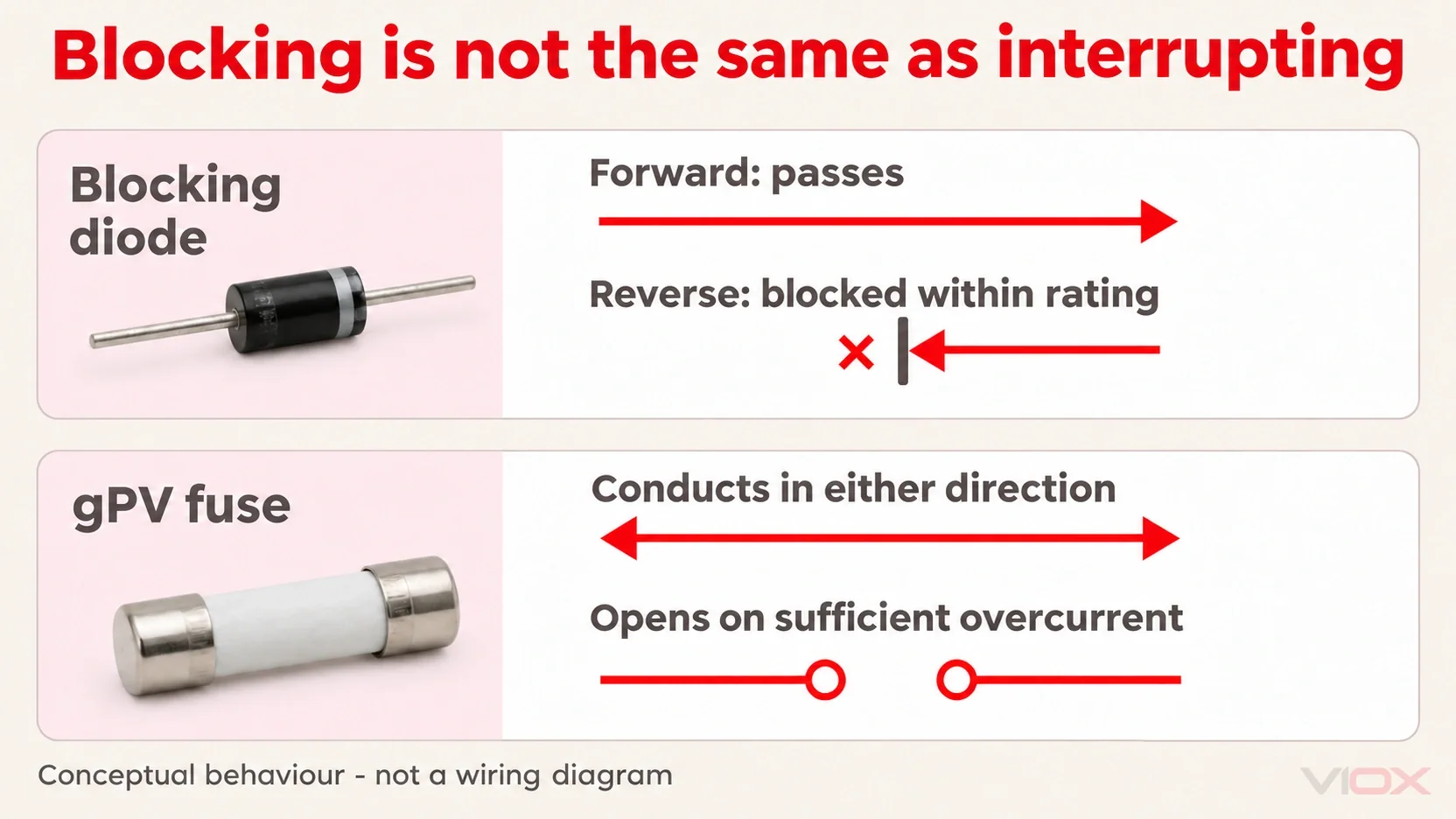
A blocking diode is connected in series with a string and oriented to pass its normal output current while opposing reverse flow. Within its ratings, it prevents that return path. A fuse instead allows current in either direction until the current and duration reach its clearing characteristic.
| Situation | Without a series blocking diode | With a correctly specified blocking diode |
|---|---|---|
| Normal generation toward the inverter | Output current flows through the conducting string path | Output current passes through the diode, producing forward-drop losses |
| Sufficient voltage mismatch drives current toward a string | Reverse current can flow; a coordinated fuse interrupts if its operating conditions are reached | The diode opposes the reverse path within its ratings |
Ordinary partial shade is not automatically that fault scenario. Shading changes the string's output characteristic, but a matched shaded string does not necessarily receive damaging reverse current. The actual voltage difference and inverter operating point matter.
Bypass diodes are not blocking diodes
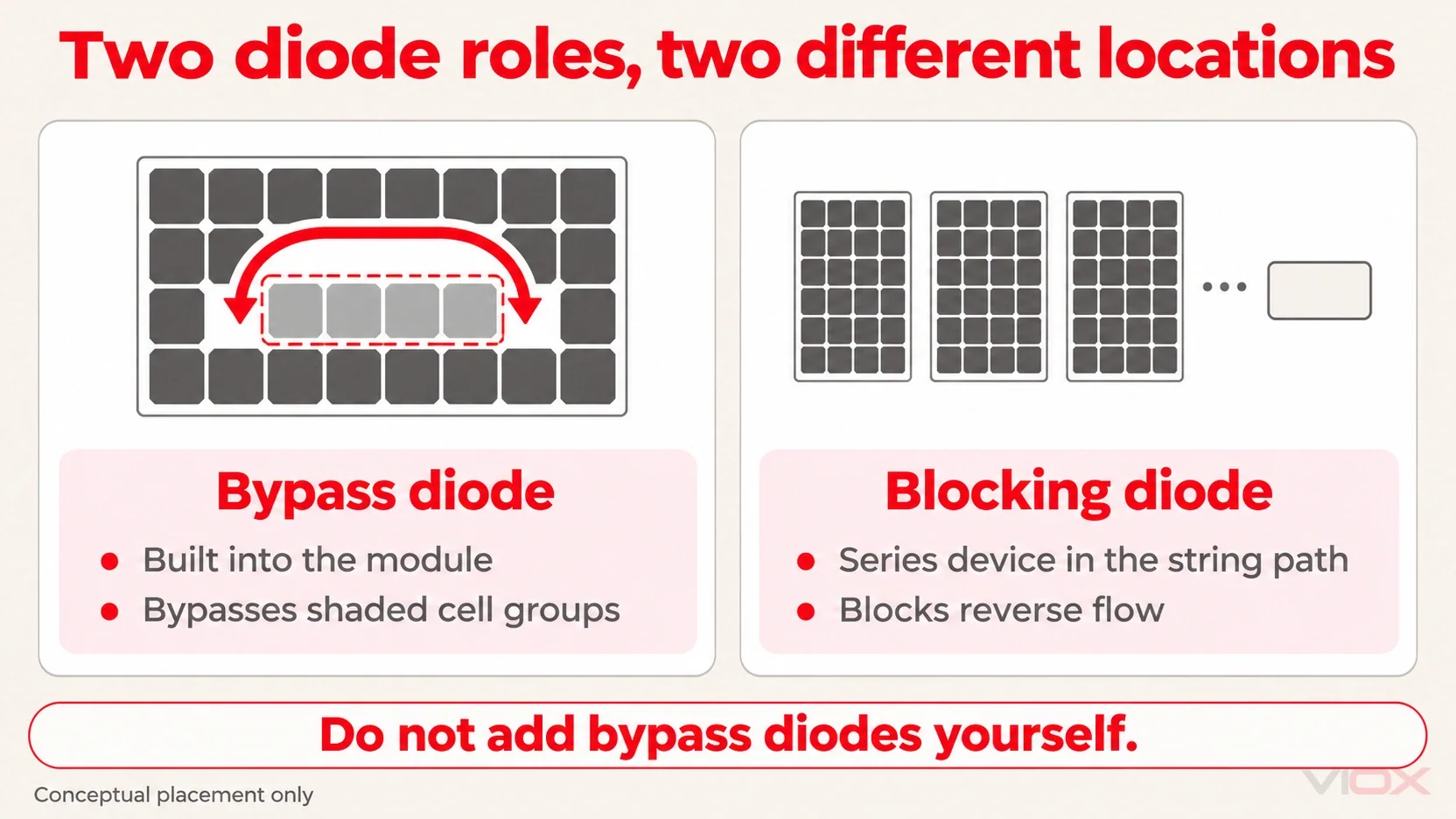
| Point | Module bypass diode | String blocking diode |
|---|---|---|
| Position | Built into the module assembly, commonly in its junction box, across cell groups | In series with the string path when the design specifies it |
| Job | Gives current a path around shaded or affected cell groups, reducing hot-spot risk | Opposes current flowing backward into a string |
| Relationship to string fuses | Does not replace string overcurrent protection | Also does not replace required overcurrent protection |
Do not add bypass diodes yourself: they come built into the module. Suspected failure is a module-service issue under the manufacturer's instructions, not a reason to improvise a diode arrangement in the combiner.
Why fuses replaced diodes
1. A series diode produces heat whenever it carries current
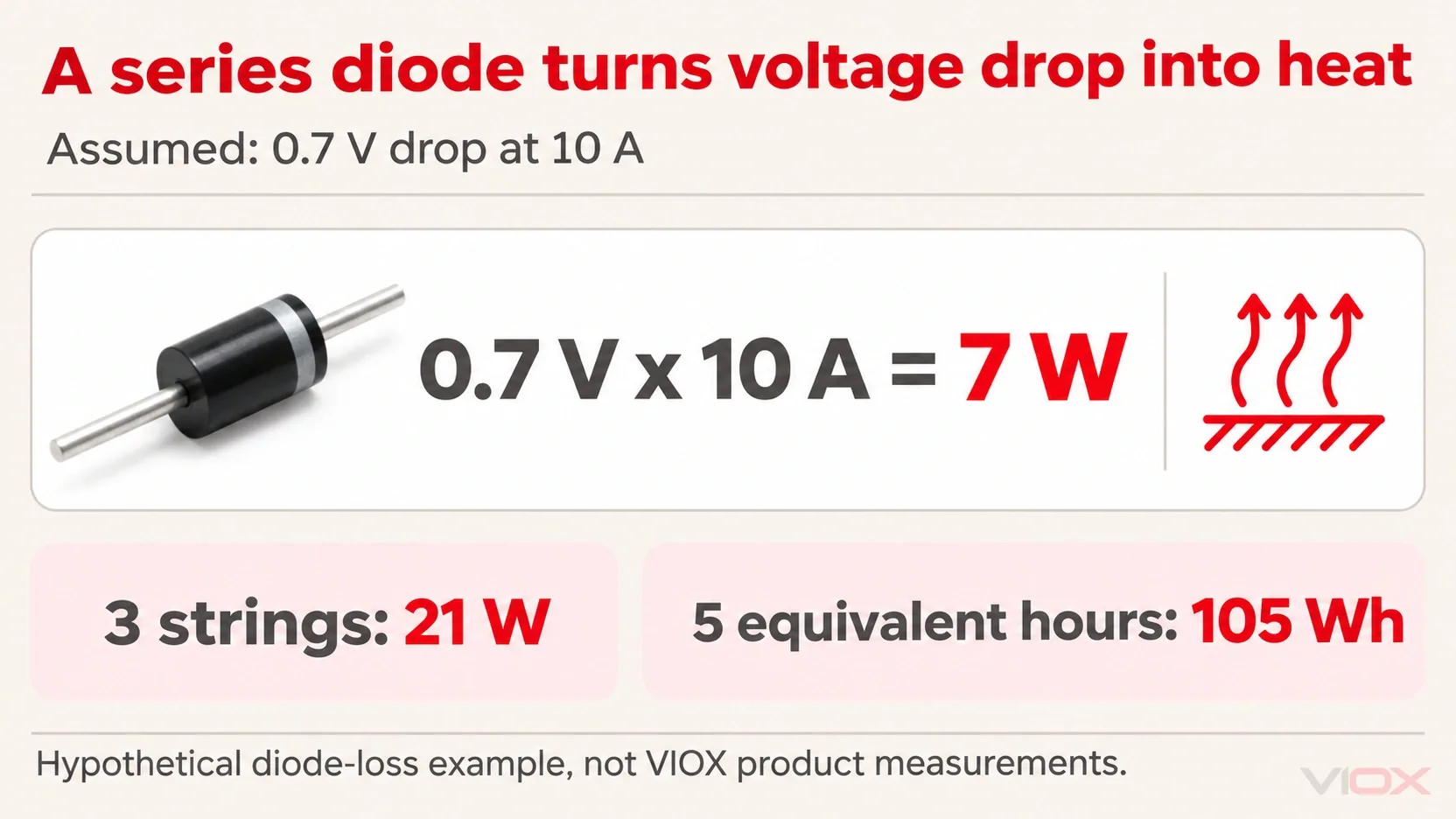
The basic loss calculation is power loss = forward voltage drop x current. That drop is paid throughout generation, not just during a fault.
For a hypothetical example, assume one diode drops 0.7 V at 10 A, and ignore variation with current and temperature:
- One string diode dissipates 0.7 V x 10 A = 7 W.
- Three strings, each carrying 10 A through its own identical diode, dissipate 21 W in total.
- Five equivalent hours at that assumed operating point produce 21 W x 5 h = 105 Wh of diode loss.
These are stated assumptions, not VIOX product measurements, a universal diode voltage drop or an annual energy-yield estimate. Actual loss must use the chosen diode's data and the real current/temperature profile. The heat also has to leave the device and enclosure.
A fuse has resistance and its own normal power dissipation. Its loss is generally much lower than adding a conventional series blocking diode for this duty, but it is not zero. Compare exact component watt-loss data under the intended conditions rather than subtracting an invented fuse-loss number.
2. The diode can fail in two unhelpful ways
A diode that fails short circuit can leave the string generating while silently removing the intended blocking function. A diode that fails open circuit interrupts the string's output. Neither outcome makes a blocking diode a substitute for the required overcurrent device.
A correctly specified fuse has a defined one-time interruption role and a replaceable link. A fuse opening during a damaging reverse-overcurrent event can be the protection doing its job. It is still necessary to identify the fault before replacing the link.
3. Fewer added components simplify the thermal and service task
A series diode adds a component, connections and a heat-removal requirement. It may add monitoring and inspection work too. Where string fusing already provides the required protection, omitting an unnecessary diode avoids that extra bill-of-materials and service scope. Fuse-link protection is generally the simpler, lower-cost arrangement for this conventional duty; no universal price saving is claimed here.
A fuse's open state is not always visible: opaque cylindrical links need the approved verification method or a suitable indication system if fitted. Replacement is straightforward only after safe isolation, fault investigation and confirmation of the correct spare. Never operate the VOPV fuse carrier under load.
ABB's Photovoltaic plants technical paper describes continuous diode losses, possible loss of the blocking function on failure, and the use of string fuses in grid-connected plants. It also discusses special module situations where a diode can remain part of the design. The engineering conclusion is to avoid an unnecessary series diode, not to remove every existing diode indiscriminately.
Standards context: IEC TS 62257-7-1, Recommendations for small renewable energy and hybrid systems for rural electrification - Part 7-1: Generators - Photovoltaic generators, is a historical rural-electrification specification, not a blanket ban on blocking diodes. Its 2010 text permits specified uses and distinguishes blocking from overcurrent protection. IEC now lists that edition as withdrawn. Use the applicable array-design rules and module instructions for a new project.
When reverse current actually matters
One or two parallel strings: often no additional reverse-current device
With one conventional string and no other backfeed source, there are no healthy parallel strings feeding a fault into it. With two matched parallel strings, the contribution into a faulted string comes from just one healthy string, bounded by that source's available current.
That often permits operation without an additional string fuse or blocking diode for this reverse-current exposure, but it is not an unconditional exemption. Check the corrected source current, module instructions, conductor/connector limits and any inverter, battery or other possible backfeed source. This says nothing about removing other required isolation, surge protection or system protective measures.
Three or more parallel strings: assess each string for backfeed protection
Now two or more healthy strings can contribute to a faulted branch. Individual string fuses are the common solution when their combined possible backfeed exceeds the permitted module or circuit limits. In many conventional designs this is why every parallel string is fused.
Do not use the string count as the complete acceptance test. On the exact module datasheet, look in the electrical ratings or maximum-ratings section for "Maximum Series Fuse Rating", sometimes called the maximum overcurrent-protection rating. Check the matching installation manual and any separately specified reverse-current limit. The maximum fuse value is an upper protective-device limit, not an instruction to choose that amperage automatically.
For an example of manufacturer-specific conditions, Canadian Solar's module installation manual couples its parallel-string guidance with limits on reverse current and module fuse rating. Apply the instructions for the actual modules installed, not another manufacturer's exemption.
Will a heavily shaded string blow its fuse?
Normally, shading alone should not operate a correctly coordinated fuse in a healthy, matched array. The inverter's operating point and the strings' current-voltage characteristics determine whether each string delivers current. Lower output from a shaded string is not proof that a large current is flowing backward through it.
SMA's reverse-current technical note explains why ordinary shading of correctly matched strings is different from a fault that substantially lowers one string's voltage. Severe mismatch, damaged bypass diodes or abnormal inverter operation require a broader assessment; do not promise that no reverse current can ever occur outside a simple short circuit.
If a fuse opens when damaging reverse overcurrent is present, that is its protective role. Repeated operation still warrants investigation rather than an assumed shade-related nuisance trip or a larger replacement fuse.
Buyer checklist
- Use compatible, matched modules and an approved parallel-string/MPPT arrangement.
- Check the exact module datasheet's maximum series fuse rating and the matching installation instructions.
- Where string protection is required, specify a coordinated gPV fuse for each protected string and the required polarity arrangement in the combiner.
- Do not add series blocking diodes routinely; retain them where the approved design or manufacturer requires them.
- If an old system already has blocking diodes, have qualified personnel assess heat, forward voltage drop and the original protection design before deciding on any removal or change.
Where VIOX products fit
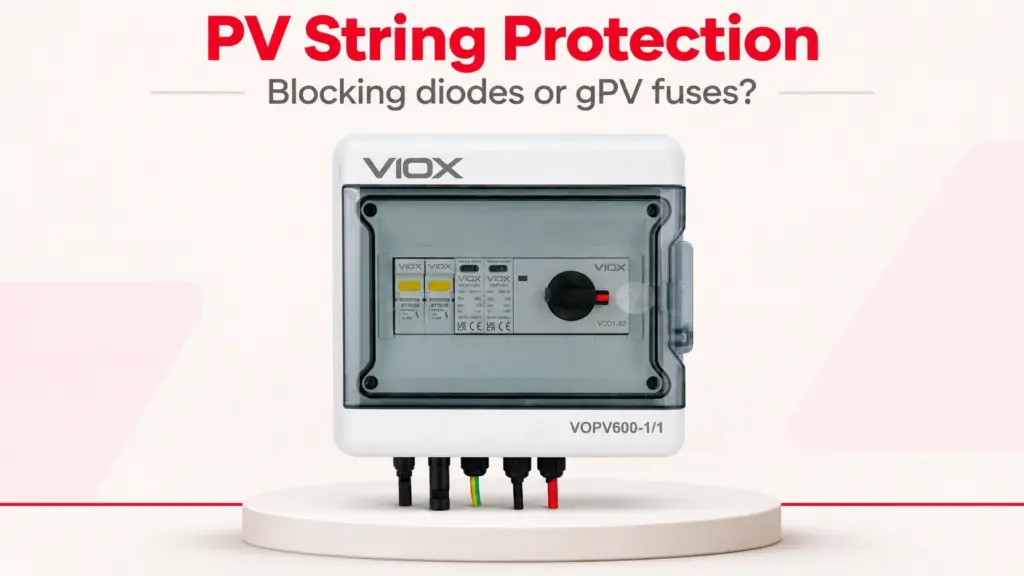
VIOX Solar does not sell blocking diodes. Its relevant products are the PV fuse-link/holder platforms and documented string-protection assemblies.
| Verified product | Published PV DC data | Application boundary |
|---|---|---|
| VOPV-32 | 10x38 mm, 1-32 A options, 1000 V DC, stated 33 kA platform breaking capacity | Use the PV DC version with a coordinated gPV link; the related RT18 AC version is not interchangeable |
| VOPV-63 | 14x51 mm, 8-50 A options, 1000 V DC, stated 50 kA platform breaking capacity | Separate larger-format platform; this does not establish that it is fitted inside the listed combiner boxes |
The breaking-capacity figures are the product pages' declared platform data. They do not give an empty holder an interruption function or qualify an arbitrary fitted fuse. Confirm the exact link-holder combination and controlled documents.
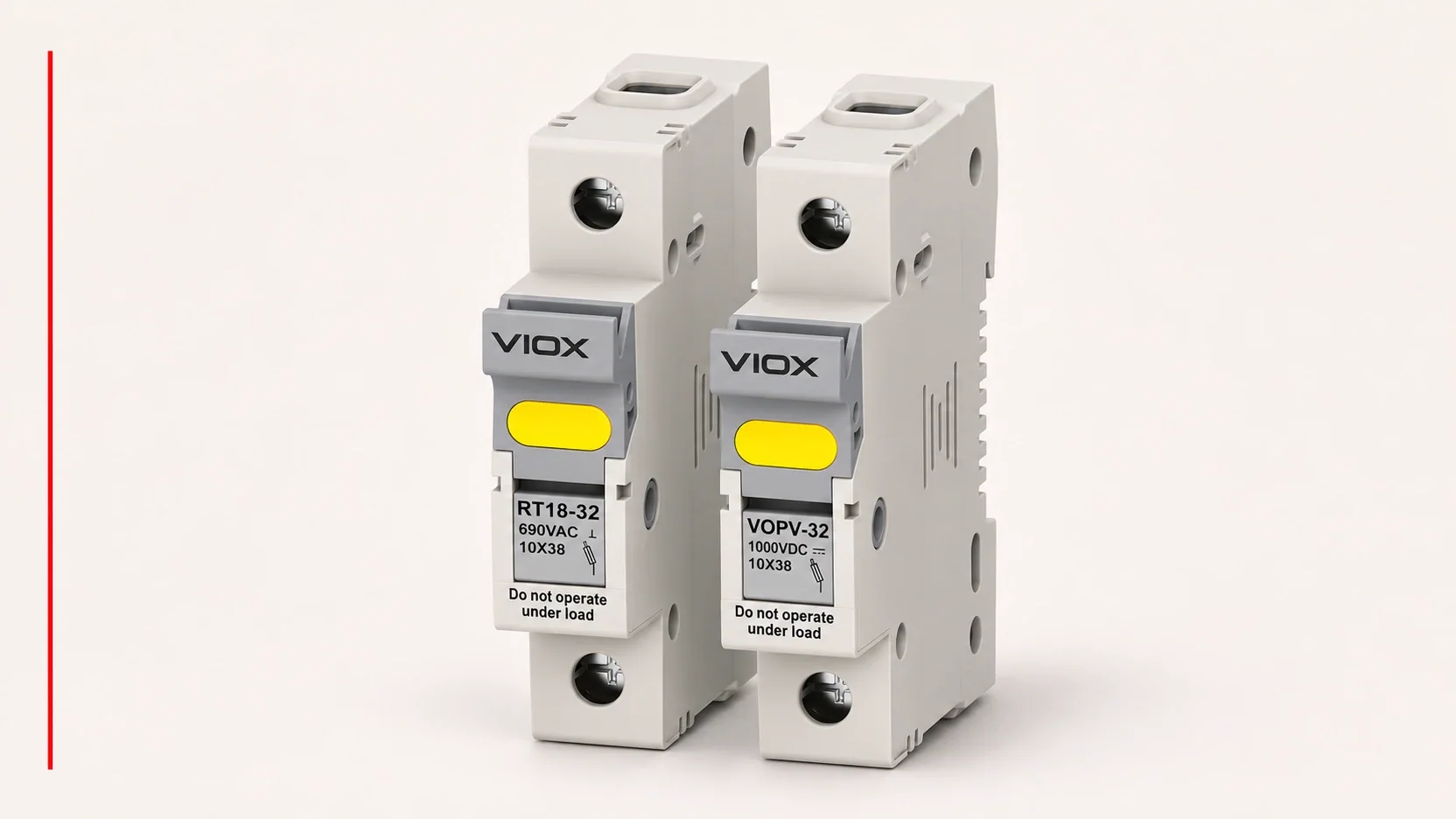
The verified VOPV600-1/1 and VOPV1000-3/1 pages list VOPV-32 holders with 15 A, 10x38 mm links, alongside Type 2 40 kA DC surge protection and VOD1 isolation in IP65 enclosures. The 600 V/1000 V range covers one to three inputs across models. Its published BOM does not justify claiming that VOPV-63 is installed in those boxes, or that every project suits the supplied 15 A links.
VIOX Solar does not offer a 1500 V combiner box. For a project review, send the module reference, parallel-string/MPPT arrangement, inverter details and any existing diode circuit drawing to VIOX Solar.
Related resources
- DC Fuse Guide
- gPV vs gG Fuse
- Why Does a PV String Fuse Keep Blowing?
- What Is a PV Combiner Box?
- How to Select a PV Combiner Box
- PV Combiner Box vs Junction Box
FAQ
Do I need blocking diodes with two strings in parallel?
Normally not for two matched conventional strings feeding a grid-connected inverter, provided the approved design permits it. Only one healthy string contributes backfeed into a faulted branch, but its corrected current and any other sources must stay within the module and circuit limits. Check the module instructions; batteries, special modules and an existing engineered diode arrangement can change the answer.
What is the difference between bypass and blocking diodes?
A bypass diode is built into a module across cell groups so current can bypass shaded groups and reduce hot-spot risk. A blocking diode is a series device intended to oppose reverse current in a string or array path. Neither replaces required string overcurrent protection. Do not retrofit module bypass diodes yourself.
Will a heavily shaded string blow its fuse?
Normally, shading alone will not blow a correctly coordinated fuse in a healthy, matched array. The common operating voltage and inverter control determine string currents; reduced output is not automatically damaging backfeed. A fuse can operate if an actual fault or severe abnormal condition drives enough overcurrent through it. Investigate an open fuse before replacing it.
Can I add blocking diodes to an existing combiner box?
Only after a qualified designer checks the complete circuit, manufacturer instructions, diode ratings, heat dissipation and the existing protection arrangement. A diode is not a substitute for a required fuse and is not a routine upgrade for a modern grid-connected combiner. Likewise, do not remove an existing blocking diode solely because a general article says fuses are common.
Do blocking diodes help with partial shading?
They can oppose reverse flow when the electrical conditions would otherwise drive current backward, but they do not recover generation lost to shade or perform maximum power point tracking. Routine shade in a healthy matched array is not normally a reason to add them. Module bypass diodes and the approved string/MPPT layout address different aspects of shading, while a series blocking diode adds forward-loss heat.