
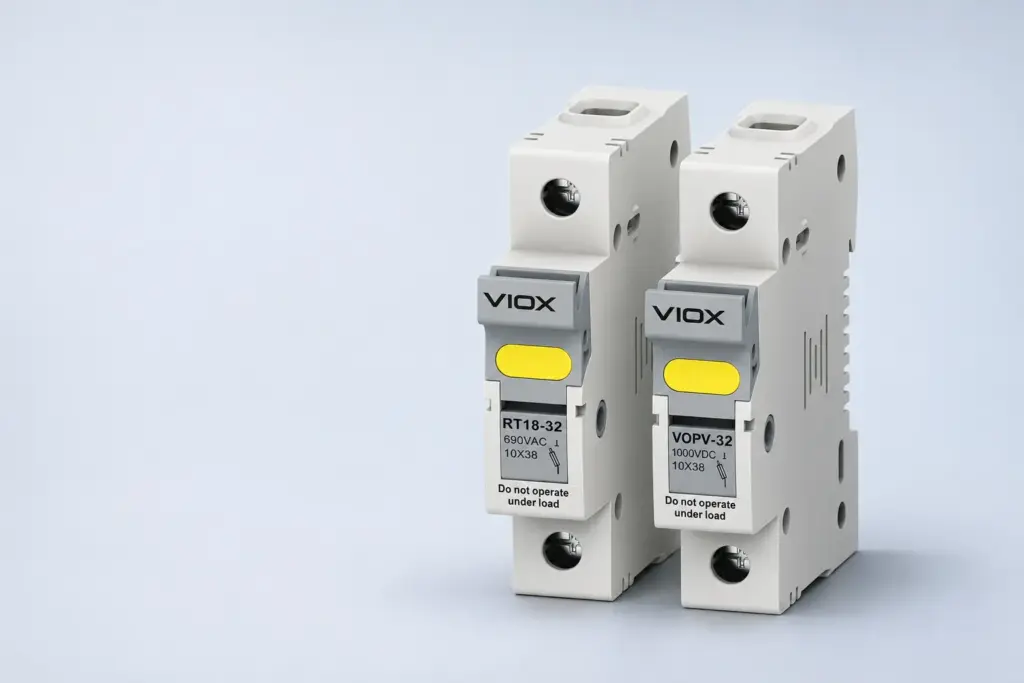
Short Answer
No. An ordinary AC gG link that fits the holder and matches the amp rating is still the wrong replacement for a PV string fuse. The general-purpose gG links considered here are tested under the IEC 60269-2 industrial-fuse framework; gPV links are tested for PV DC circuits under IEC 60269-6. Matching size and amperes does not establish safe DC interruption, low-overcurrent clearing or PV cycling performance. A small DC rating on some gG models does not qualify them for a 1000 V PV string.
The gPV vs gG fuse question often starts with a perfectly reasonable observation: both links fit. The missing evidence concerns what the fuse must do after a fault, not whether its end caps touch the holder contacts.
For terminology and general rating orientation, see the DC Fuse Guide. This comparison addresses the narrower question of substituting a cylindrical gG link for the specified gPV link inside a solar combiner box.
Why this substitution happens
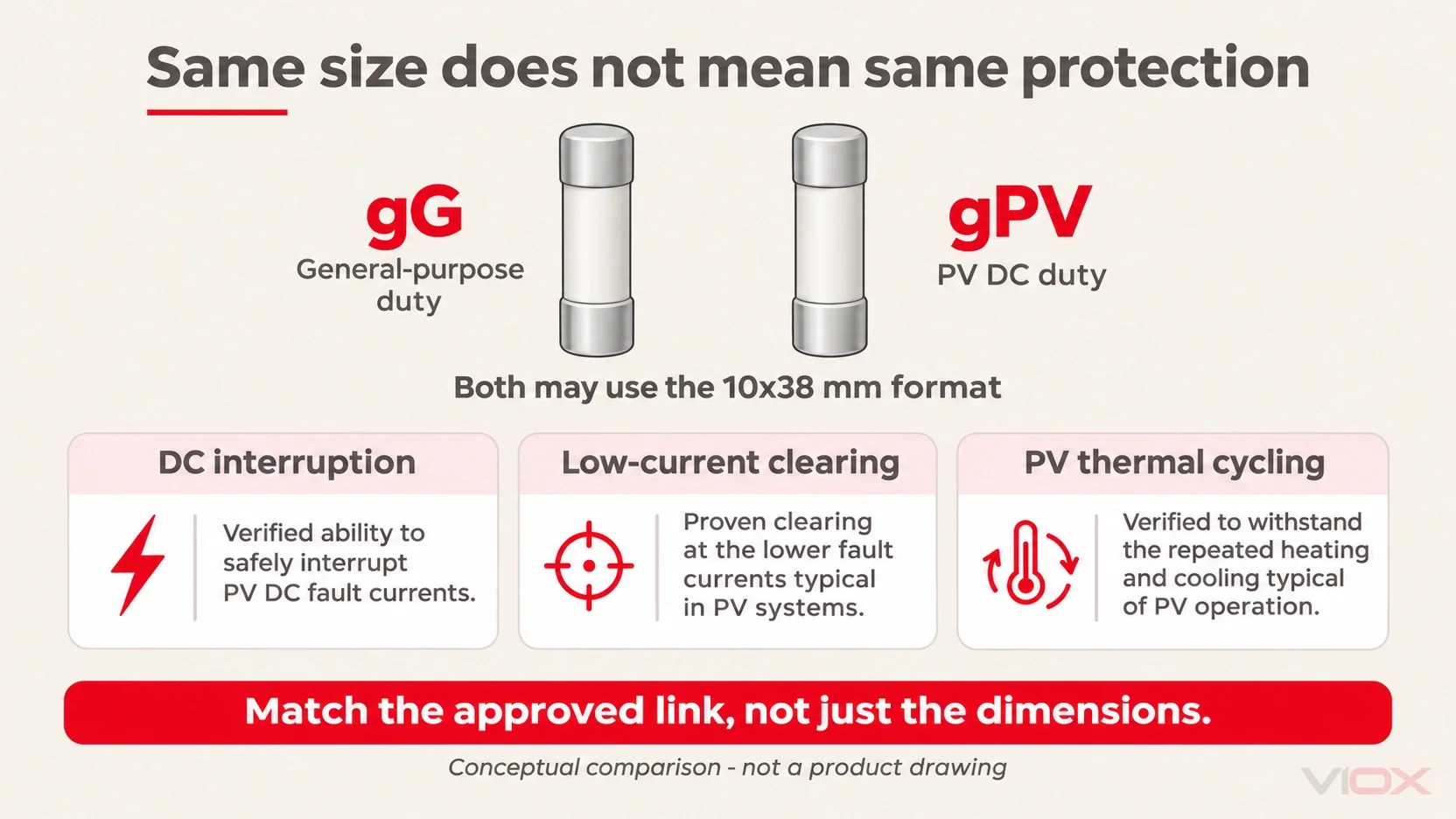
A 10x38 mm gG link and a 10x38 mm gPV link share the same nominal cylindrical format. They can fit the same nominal-size carrier, and their printed amp ratings can match. Neither the ceramic body nor the metal caps makes the application difference obvious.
The maintenance decision can therefore look practical: the gG link is already in the spares drawer, may be cheaper to source, and appears to restore the same circuit without changing the holder. A buyer comparing a size, an amp rating and a unit price can reach the same conclusion.
That reasoning establishes a possible mechanical fit, not an electrically equivalent replacement. The link still needs to interrupt the actual DC circuit under the fault conditions that a PV array can produce. The holder cannot supply an interruption characteristic that the fitted link lacks.
Why a gG link is not tested for this job
1. A DC arc has no natural current zero crossing
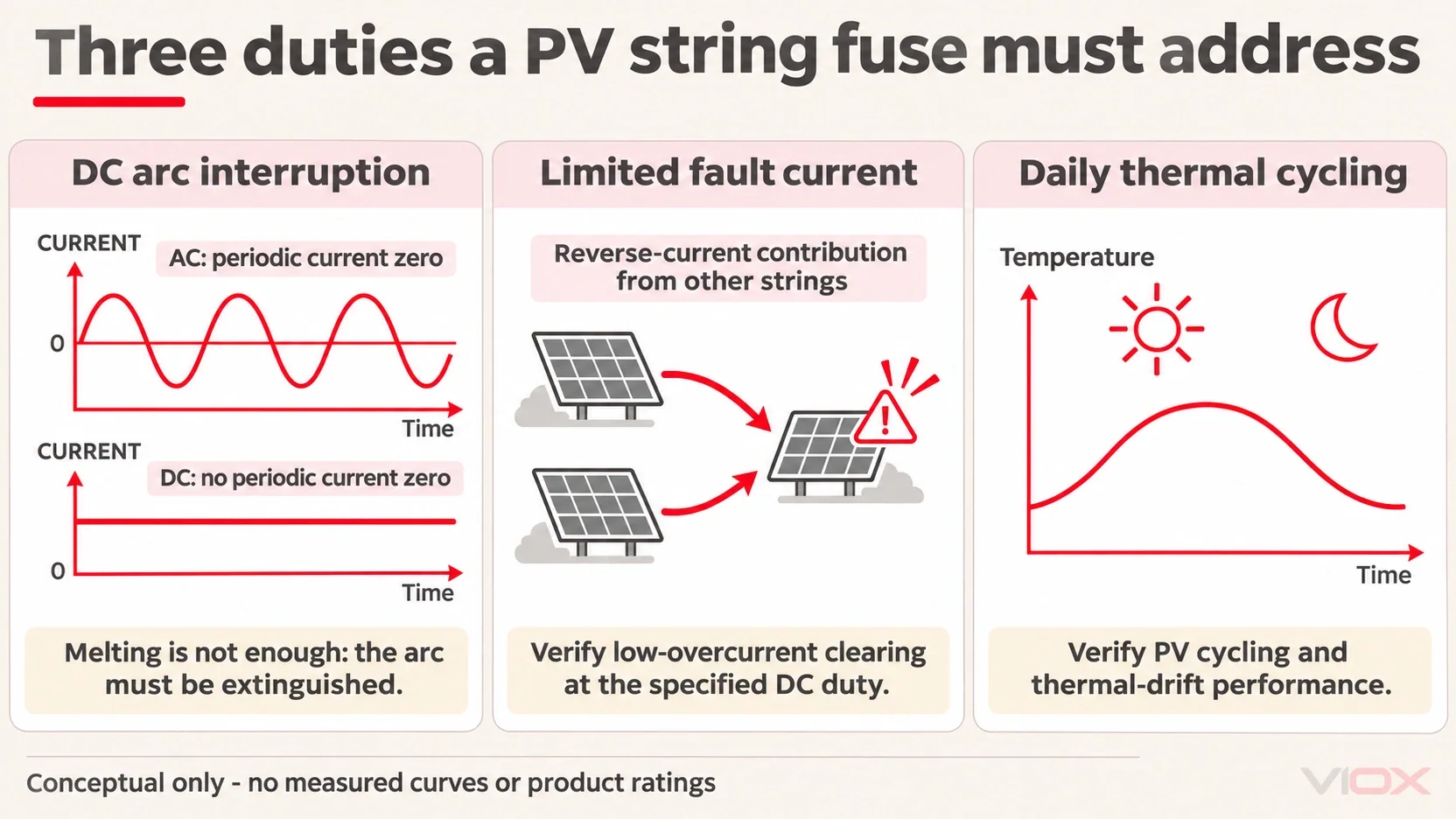
When the element melts, current does not necessarily stop immediately: an arc can bridge the gap. Alternating current passes through zero each cycle, assisting arc extinction. PV direct current has no equivalent periodic current zero, so the fuse must extinguish the arc under its specified DC conditions. Eaton's fuse technical FAQs explain this difference.
A 500 V AC or 690 V AC marking is not a 1000 V DC interrupting rating. An ordinary AC gG link does not have verified 1000 V DC interruption merely because it sits in a holder marked 1000 V DC. If the link is unable to extinguish the arc, melting the element may fail to disconnect the fault safely.
Some gG references have a separate, lower DC voltage rating. That rating applies only to its declared voltage and test conditions. It cannot be extended to the much higher voltage of a PV string.
2. PV fault current can be too modest for the assumed clearing behaviour
A faulted PV string can receive reverse current from healthy parallel strings. Unlike a fault supplied by a stiff utility source, this contribution is limited and can be only a low multiple of normal operating current. Protection therefore has to work at modest overcurrents as well as withstand the circuit voltage.
The gPV test framework addresses low-current DC interruption under specified circuit conditions, including the DC time constant. In plain language, the test controls how the current behaves during interruption; it is not just a large short-circuit test with a kA number attached. Eaton's PV application guide explains the combination of high DC voltage and limited fault current that drives gPV design.
A gG link of the same amperage has a different required operating characteristic. At a low overload, it can remain conducting and hot for a prolonged period rather than clear within the time needed for the PV protection task. This does not mean gG links never clear overloads; it means their general-purpose characteristic is not evidence of equivalent PV protection. Exact clearing times require the relevant manufacturer's curve and test conditions, not a universal claim that one class always blows first.
3. Daily thermal cycling is part of the PV duty
A combiner warms as sunlight and string current rise, then cools as generation falls. Ambient temperature changes add another cycle. Repeated expansion, contraction and heating affect the link's long-term behaviour, even when it carries normal current without opening.
IEC 60269-6 includes PV-specific verification for cycling and thermally induced drift, with subsequent checks of fuse performance. A general-purpose gG designation does not demonstrate that the link has passed those PV-specific requirements. It would be inaccurate to say that all gG products receive no thermal testing; the missing evidence is qualification for this PV duty. The IEC 60269-6 consolidated preview identifies these verification topics. Mersen's PV fuse information also describes construction for repeated temperature and current cycling.
gPV vs gG fuse: comparison for cylindrical combiner links
This table compares a specified PV string link with an ordinary industrial AC gG alternative. It does not declare every gG product unsuitable for every DC application.
| Comparison | gPV link for the specified PV circuit | Ordinary AC gG replacement |
|---|---|---|
| Standard | IEC 60269-6 supplementary PV fuse-link requirements, with IEC 60269-1 | IEC 60269-2 industrial-fuse requirements, with IEC 60269-1; not PV qualification |
| Intended circuit | PV strings and arrays within the exact product's declared application | General-purpose industrial distribution and equipment protection within declared ratings |
| Voltage rating basis | Explicit DC rating matched to the maximum PV circuit voltage | Usually the marked AC rating; a separately declared DC rating, if any, has its own limits |
| Breaking-capacity test basis | Specified DC voltage, prospective current and time constant, including the required PV interruption tests | Declared industrial-fuse test duty; an AC kA figure cannot be transferred to PV DC duty |
| Behaviour at low overcurrent | PV-specific operating requirements and verified low-current interruption | General-purpose operating characteristic; same amperes does not establish the same low-current clearing performance |
| Typical cylindrical formats in combiner boxes | 10x38 mm and 14x51 mm in the VIOX range; format alone is not approval | Similar nominal cylindrical formats exist; fitting the carrier proves no electrical equivalence |
| Markings to look for | gPV, explicit DC voltage, amp rating and identifiable reference; verify IEC 60269-6 in the marking/documentation | gG, commonly an AC voltage and amp rating; a lower separate DC rating is not a gPV marking |
The standards have different scopes: IEC 60269-2 covers industrial fuse systems, including cylindrical-contact formats, while IEC 60269-6 specifically addresses PV string and array fuse-links. Neither standard title establishes that an unidentified product complies.
How to check what is actually fitted
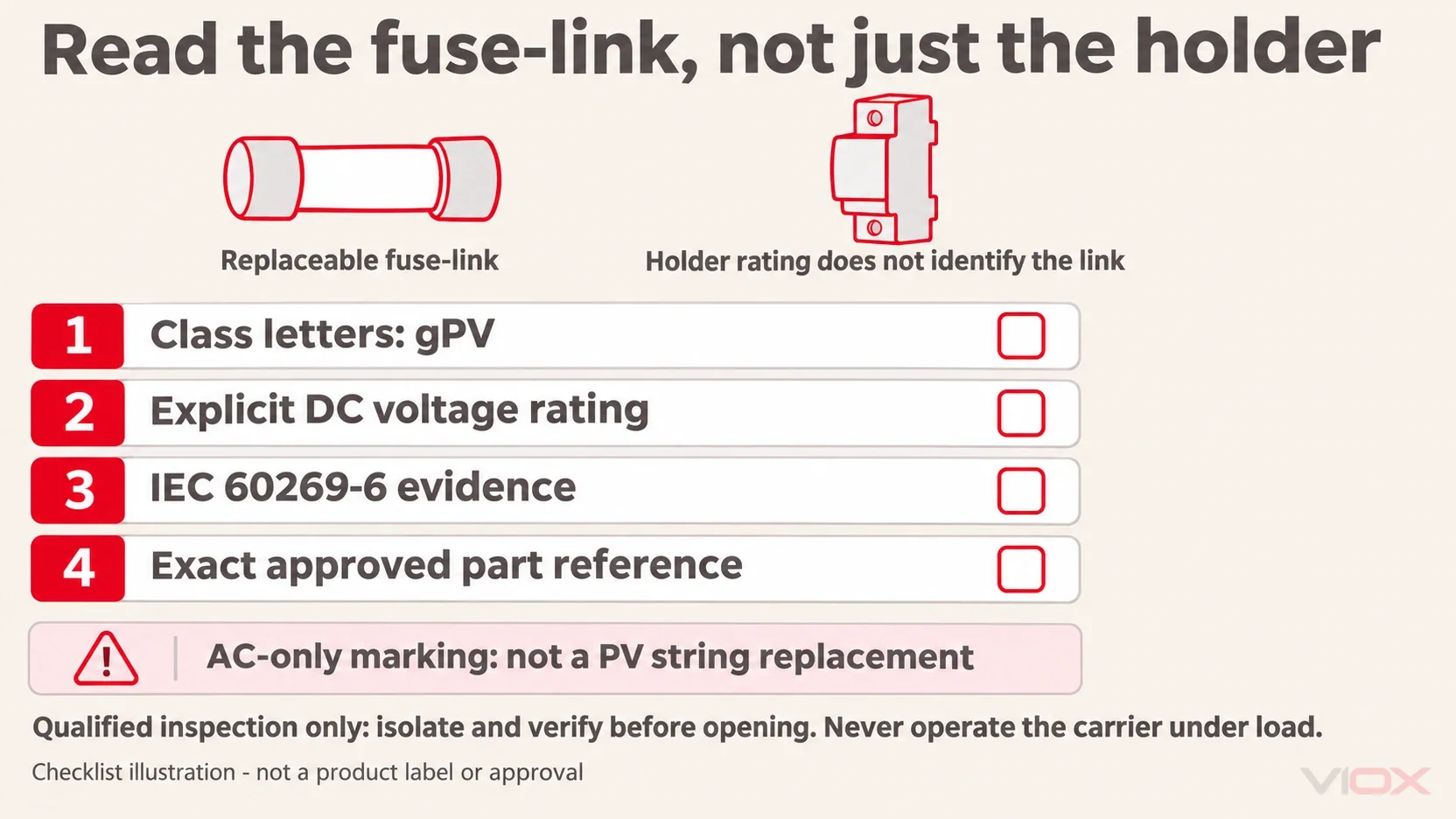
Read the link, not just the holder. A holder's 1000 V DC label identifies the holder version; it does not identify the fuse hidden inside it.
Have qualified personnel check the fitted link under the site's safe isolation procedure. The VIOX product instructions say not to operate the fuse carrier under load. Do not open a live carrier to read a label.
Check these items on the link and its traceable documentation:
- Class letters: look for gPV, not merely the ampere value or the word "fuse."
- DC voltage: confirm an explicit DC rating suitable for the maximum circuit voltage. An AC-only marking fails this check.
- PV standard reference: look for IEC 60269-6 on the marking or the exact manufacturer's datasheet. A generic IEC 60269 reference alone is insufficient.
- Part identity: match the link reference to the approved combiner bill of materials and replacement schedule, including current and format.
If the fitted link shows only an AC rating and no traceable DC/PV qualification, it does not belong on a PV string, whatever its size and amp rating say. If markings are unreadable or documentation conflicts, treat the replacement as unverified rather than infer suitability from the carrier.
For example, "10x38, 15 A" on a spare and "1000 V DC" on the existing holder do not combine into a verified 1000 V DC, 15 A gPV fuse assembly. The link itself must have the necessary duty and voltage evidence.
What about a low-voltage DC rating or a battery fuse?
A gG datasheet may include a lower DC rating applicable to a control or other specified DC circuit. That is real product data, but it does not qualify the link for a 1000 V PV string. Likewise, fuse classes selected for battery-storage fault sources answer a different application question. Neither exception turns an ordinary gG link into the specified gPV replacement for this combiner duty.
Which links fit the VIOX PV fuse platforms?
The product pages state: "AC and photovoltaic DC ratings are not interchangeable." Preserve that distinction when ordering both holders and spare links.
| Verified VIOX product | PV DC version data published on the product page | Replacement implication |
|---|---|---|
| RT18-32 / VOPV-32 | VOPV-32: 10x38 mm, 1-32 A options, 1000 V DC, stated 33 kA breaking capacity | Use the VOPV DC version with a coordinated gPV 10x38 mm link; do not substitute an RT18 AC version or an AC gG link |
| RT18-63 / VOPV-63 | VOPV-63: 14x51 mm, 8-50 A options, 1000 V DC, stated 50 kA breaking capacity | Use the VOPV DC version with a coordinated gPV 14x51 mm link; the "63" model name is not a published 63 A option |
| VOPV600-1/1 and VOPV1000-3/1 | Published bills of materials include VOPV-32 holders and 15 A, 10x38 mm string fuse links in the 600 V and 1000 V combiner ranges | Match the exact supplied link and approved assembly documents; a same-size 15 A gG link is not an equivalent spare |
The 33 kA and 50 kA figures above are the product pages' stated PV DC platform breaking capacities. They are not independent interruption ratings for an empty holder or a promise that any fitted link achieves those figures. Confirm the exact link-holder combination and controlled documentation.
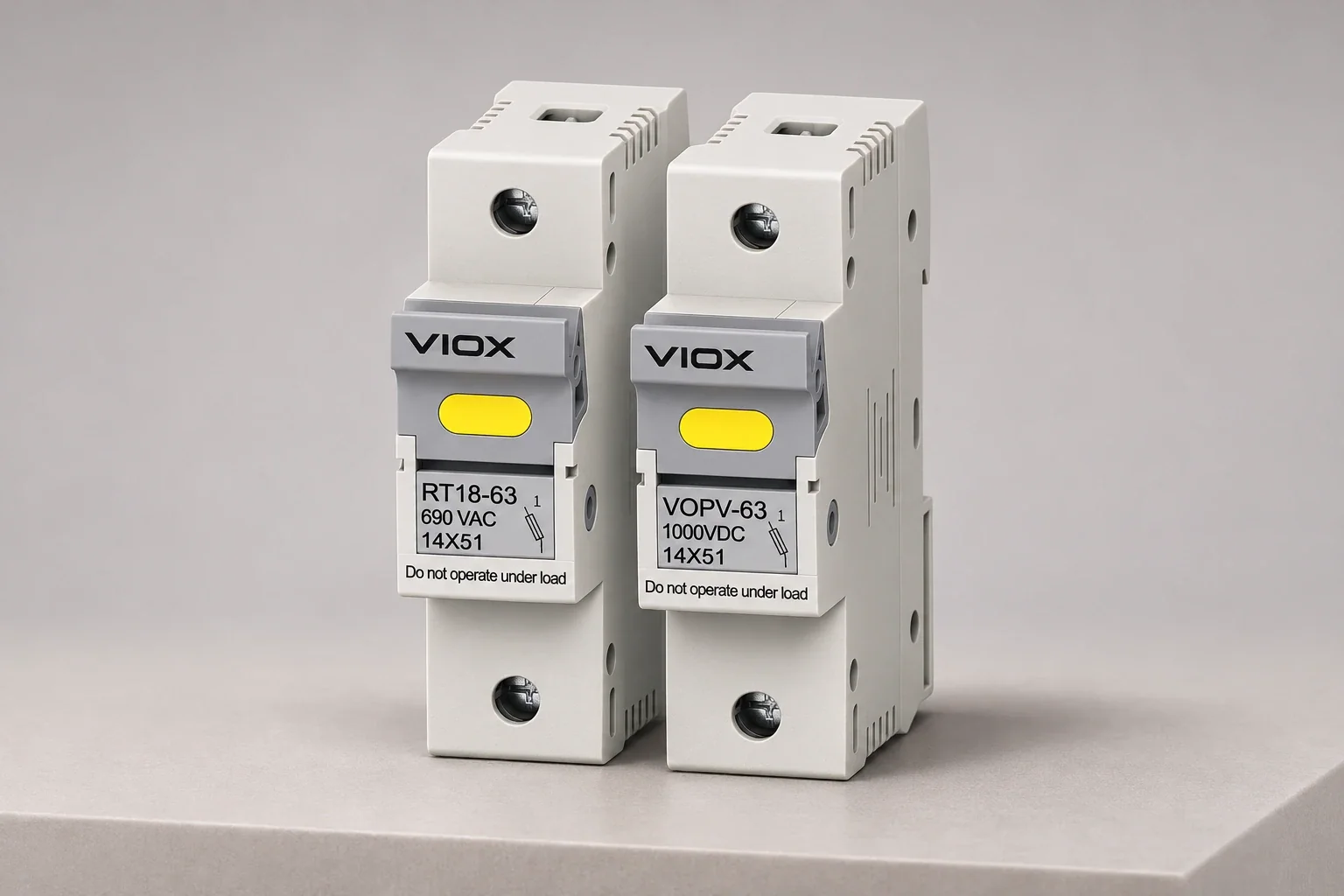
For a replacement inquiry, send the fitted link reference or an existing safe inspection photograph, the combiner model and the approved parts schedule to VIOX Solar. Do not increase the amp rating to compensate for an unsuitable class.
Related resources
- DC Fuse Guide
- Why Does a PV String Fuse Keep Blowing?
- What Is a PV Combiner Box?
- PV Combiner Box vs Junction Box
FAQ
Can I use a gG fuse in a solar combiner box?
No, an ordinary AC gG link is not a substitute for the specified gPV string fuse. Matching dimensions and amperes does not establish PV DC interruption, low-overcurrent clearing or cycling performance. Use the approved gPV link with an adequate DC voltage rating and the documented holder combination.
What happens if a gG fuse is fitted on a PV string?
The circuit may initially operate, but the replacement can leave the string without verified protection. At a modest reverse-current fault it may remain conducting longer than the PV duty permits, and an AC-only link may fail to extinguish an arc at PV DC voltage. Normal generation does not demonstrate that the replacement can clear a fault safely.
How can I tell a gPV fuse from a gG fuse?
Check the fuse-link's class letters, explicit DC voltage rating and exact part reference, then verify IEC 60269-6 evidence in its marking or manufacturer documentation. A gG marking or an AC-only voltage rating does not identify a gPV link. Read the replaceable link itself; the holder label cannot establish its class.
A 10x38 gG link shows a small DC rating; is it OK for PV strings?
No, that lower DC rating does not qualify it as a replacement for a specified gPV link on a 1000 V PV string. A DC rating applies only within its declared voltage and circuit conditions. The replacement still needs verified PV duty, adequate DC voltage and the correct operating characteristic; the 10x38 format alone proves none of these.
Which fuse class do VOPV fuse holders take?
For PV service, VIOX specifies coordinated gPV links: 10x38 mm for VOPV-32 and 14x51 mm for VOPV-63. Select the approved link current, DC voltage and documented combination for the circuit. The related RT18 AC versions and their ratings are not interchangeable with the VOPV photovoltaic DC versions.