
Short Answer
A plain junction box only joins cables; a protected PV combiner box joins strings AND protects each one. Choose a junction box when you only need a cable transition and required protection exists elsewhere. Choose a protected combiner when parallel strings need individual protection and a common inverter feed. The product name alone does not guarantee fuses, surge protection or isolation: verify the circuit diagram and included devices.
The practical combiner box vs junction box decision is about what happens to each circuit inside the enclosure. Does it remain separate? Does it join other strings? What interrupts a damaging current? Two boxes can look similar while answering those questions differently.
For the general background, see What Is a PV Combiner Box?. Here, the focus is deciding which enclosure function your solar design actually needs.
First, identify which "junction box" you mean
Solar drawings and supplier listings use the term for three different things. Check the location and circuit role before comparing prices.
| Name used in the project | Where to identify it | What it means for your decision |
|---|---|---|
| Module junction box | Factory-mounted on the panel backsheet or rear glass, with the module's output leads | Part of the panel assembly. It commonly contains bypass diodes; it is not a field enclosure for combining array strings. |
| DC pass-through junction box | A separate enclosure at a cable transition or collection point | Contains terminals or splices. Separate circuits can pass through without being paralleled. A plain version adds no string fuses, SPD or load-break switch. |
| PV combiner box, sometimes called an array junction box | Between PV strings and the inverter's DC input | Collects array circuits. A protected version adds specified protection and switching; its output arrangement determines whether strings combine or stay separate. |
The module box is the important exception to the shorthand "only joins cables": bypass diodes have a module-level role, but they do not replace string overcurrent protection. Roofit.Solar's module manual explicitly distinguishes bypass diodes from overcurrent protective devices.
PV combiner box vs junction box: full comparison
This table compares a plain connection-only enclosure with a protected string combiner. Other combiner configurations exist, so the supplied bill of materials remains decisive.
| Comparison point | Module junction box | Plain DC pass-through junction box | Protected PV string combiner box |
|---|---|---|---|
| String combining | No array-string combining; connects the module's internal circuit to its leads | Normally none. Joining strings on common terminals creates an unprotected combining point unless protection is provided elsewhere | Combines specified strings into a common output; multi-output models may instead preserve separate circuits |
| Per-string fusing | Normally none; bypass diodes are not string fuses | None in a plain terminal/splice box | Individual string fuses, or another specified suitable overcurrent device, where required |
| Surge protection | Not normally an array SPD location | None unless separately fitted | DC SPD when included; VIOX models below list Type 2 protection |
| Load-break isolation | No field load-break isolator | None; terminals and connectors are not load-break switches | Available with a DC-rated load-break switch-disconnector; verify inclusion and ratings |
| Output current | Carries the module/string current within the module assembly rating | Must carry the current of each routed circuit; any common connection must carry the combined current | Combined output carries the sum of parallel-string currents; the complete assembly and inverter input impose limits |
| IP rating | Module-specific; check the panel documentation | Enclosure-specific; a high IP rating adds no electrical protection | Enclosure-specific; the listed VIOX VOPV600/VOPV1000 models are IP65 |
| Cost level | Usually included in the panel cost; not an alternative system enclosure purchase | Lower initial component cost for connections alone | Higher initial cost because it includes protective and switching equipment; compare equivalent functions |
| Typical system size or topology | Present on individual modules in systems of any size | Single-string or separately routed MPPT circuits; also cable transitions in larger arrays | Multiple parallel strings feeding a common input; used according to circuit architecture, not a universal kW threshold |
A sealed enclosure does not become a protected combiner because it has several cable glands. Likewise, a larger solar installation does not automatically need an external DC combiner if its inverter already accepts separately protected string inputs.
When a junction box is enough
"Enough" means enough at that connection point. The complete system must still meet its protection and disconnection requirements.
A single string with no external backfeed source
One string has no other parallel strings feeding a fault into it. If the inverter accepts that string directly and the approved design supplies the required protection and isolation elsewhere, a suitably rated pass-through box can handle a necessary cable transition. If no transition is needed, a separate junction box may also be unnecessary.
Do not add a combiner merely because the string contains many modules. Modules in series increase string voltage; they do not create additional parallel-string inputs. Battery-connected equipment or another possible DC backfeed source requires a separate review.
One string per independent MPPT
If each string goes to its own independent maximum power point tracker (MPPT), keep those circuits separate. A multi-circuit pass-through enclosure can organize the cables without electrically joining them.
Count electrical inputs, not just sockets. Two pairs of inverter connectors can share one MPPT or an internal parallel connection. Confirm the inverter's input diagram before deciding that no reverse-current assessment is needed. Combining strings intended for different MPPTs changes the design rather than simply reducing cable count.
Module-level electronics with the required functions already provided
Microinverters convert DC at the modules, so their collection wiring is AC. An AC junction box or AC combiner may be appropriate; a PV DC string combiner is not a substitute. Enphase's installation guide illustrates an AC junction-box connection for a microinverter branch circuit.
DC optimizers are different: their outputs can still form DC strings. Follow the optimizer/inverter manufacturer's approved architecture. Some systems allow the required protection to be handled without an external fused combiner, subject to their specific conditions. SolarEdge's EU/APAC string-fusing note gives model- and wiring-dependent provisions. Do not extend those provisions to all optimizers or to rapid-shutdown devices.
When you must use a combiner box
Use a protected combiner when your design combines strings externally and their possible backfeed requires individual string protection that is not already provided by an approved arrangement. The mandatory function is protection; a separate enclosure is not universally mandatory if equivalent protection is correctly integrated elsewhere.
Parallel strings can exceed the module's protection limit
Healthy parallel strings can feed current backward into a faulty string. If that possible backfeed can exceed the module's maximum series fuse rating, a plain junction box is not an acceptable unprotected substitute. Check any separately declared reverse-current limit, cable and connector limits, and the module instructions as well. The maximum series fuse rating limits the protective fuse size; it is not a normal operating-current target.
For conventional strings, the first screening question is how much current the other parallel strings can contribute to the faulted branch. Two strings are therefore not an automatic "combiner required" rule: only one healthy string contributes, but its corrected current and any other sources must still be checked. More parallel strings increase the available contribution. SMA's reverse-current technical note explains this fault path and the role of individual string fuses.
For device selection and coordination, use the DC Fuse Guide.
The design calls for one protected, isolated inverter feed
When several compatible strings must arrive at the inverter as one DC feed, a combiner can provide the planned collection point, string protection, surge protection and load-break isolation in one assembly. Verify that all strings belong on that same input and that the inverter accepts the combined current.
A common output isolator disconnects the inverter-side feed; it does not automatically separate the strings from each other or make the array-side enclosure dead. Specify individual branch isolation separately if the maintenance plan requires it. Fuseholders are not automatically load-break devices.
Use the PV Combiner Box Selection Guide once the need for this architecture is established.
What goes wrong if a plain junction box replaces required string protection?
Unprotected reverse current: common terminals connect the faulted string to the healthy strings without a protective device in its branch. A single fuse after the combining point may not interrupt current flowing between strings upstream of that fuse. The enclosure's IP rating does nothing to interrupt that electrical fault.
No local fault-isolation point: a connection-only enclosure provides no designed load-break switching point. Removing a lid or unplugging a connector is not a substitute for isolation. A protected combiner must still have the right switching arrangement; a shared output switch alone does not isolate every incoming string.
For work procedures, see the PV Combiner Box Installation and Troubleshooting Checklist.
Where VIOX VOPV600 and VOPV1000 boxes fit
The verified VIOX product pages list 600 V DC and 1000 V DC boxes, with one to three inputs across the range, 15 A string fuse links, Type 2, 40 kA DC SPDs, VOD1 load-break isolation and IP65 enclosures. Choose the input/output arrangement before comparing enclosure sizes.
| Verified product reference | Listed voltage and circuit arrangement | Relevant use |
|---|---|---|
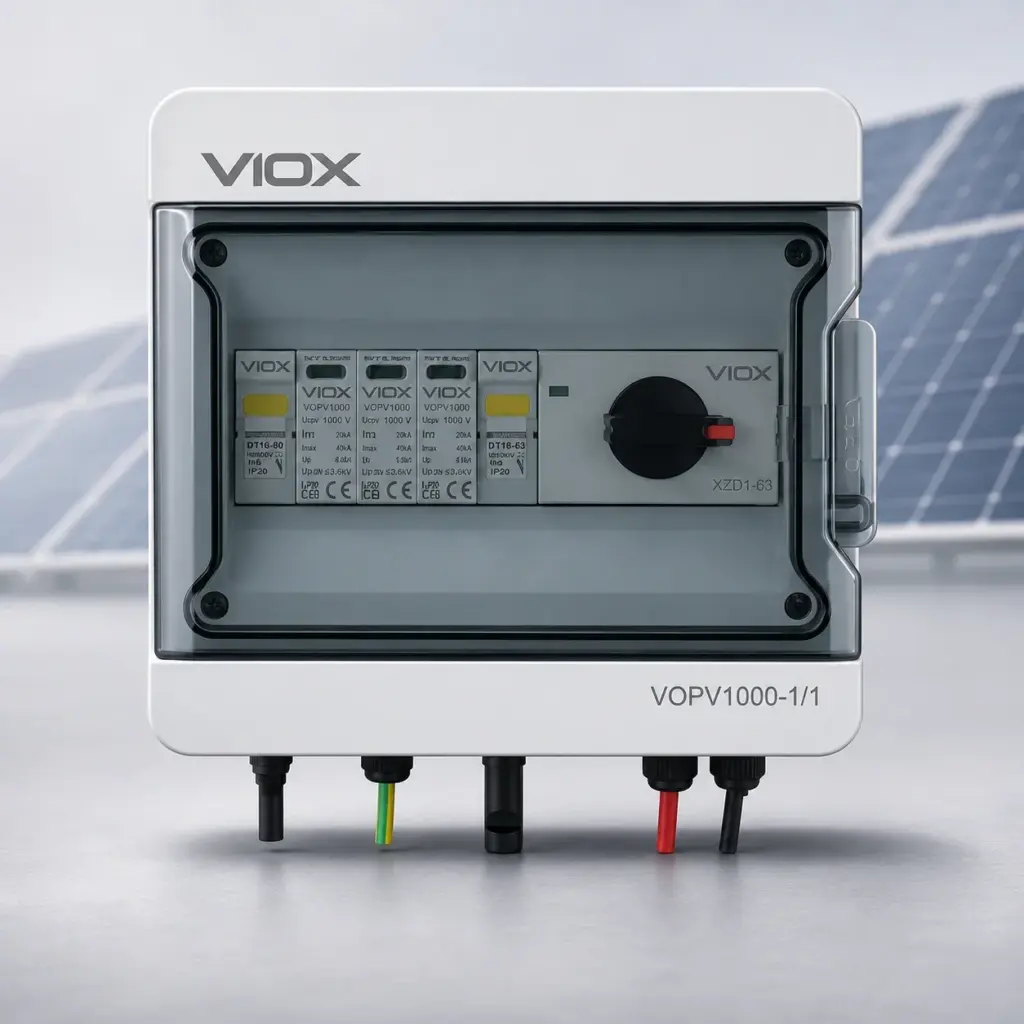
| VOPV600-1/1 and VOPV1000-1/1 | 600 V or 1000 V; one input, one output | A packaged protection/isolation point for one circuit when the design needs it; no multi-string combining |
| VOPV600-2/2 | 600 V; two inputs, two outputs | A two-circuit arrangement rather than one combined feed; confirm circuit separation in the schematic |
| VOPV1000-2/1 and VOPV1000-3/1 | 1000 V; two or three inputs, one output | Candidates for compatible strings collected into one protected inverter feed |
| VOPV1000-2/2 and VOPV1000-3/3 | 1000 V; two or three inputs with matching output counts | Multi-output protection arrangements; verify the intended MPPT separation and switching in the controlled drawing |
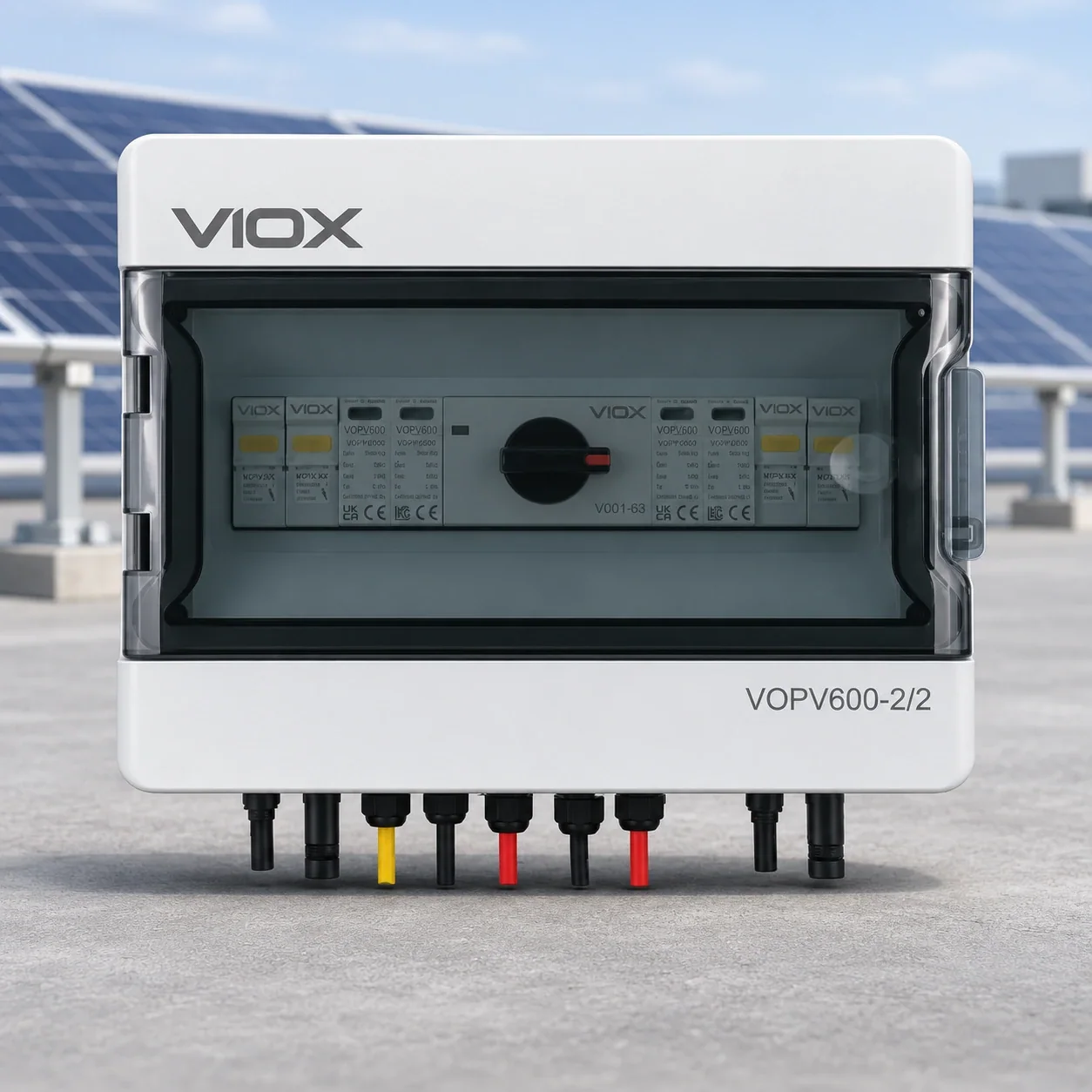
Do not confuse the headline output rating with the usable current through an installed 15 A fuse. For example, the VOPV600-1/1 page lists 32 A maximum output current and the VOPV1000-1/1 page lists 45 A, while both list 15 A fuse links. Those headline values do not authorize 32 A or 45 A through a fused string. Check the entire circuit and confirm that the supplied 15 A links suit the module and corrected string current.
These verified combiner offerings are 600 V and 1000 V, not 1500 V. For a suitable project, send the module datasheet, string-to-MPPT arrangement, inverter input limits and required output count to VIOX Solar. If a connection-only enclosure meets the design, there is no reason to buy an unnecessary combiner.
FAQ
Is a combiner box the same as a junction box?
No. A plain junction box houses cable connections; a PV combiner collects array strings and may include string protection, surge protection and isolation. A module junction box is part of the solar panel and commonly contains bypass diodes. Check the circuit diagram and bill of materials because suppliers sometimes use "junction box" for a complete combiner assembly.
Can a junction box replace a combiner box for 2 strings?
Only if the design permits those strings to be joined or routed there without losing required protection. Check possible backfeed, the module's maximum series fuse rating and instructions, conductor ratings, and inverter input limits. If string protection is required and not provided elsewhere, a plain junction box cannot replace a protected combiner. Keep strings assigned to independent MPPTs separate.
Do I need a combiner box for one string?
Usually not for combining, because there is only one string. A suitably rated junction box may be enough for a cable transition when required protection and isolation are provided elsewhere and there is no other backfeed source. A one-input protection box can still be useful if the design needs a local SPD or isolator, but it is not automatically necessary.
Does every combiner box include fuses and an SPD?
No. "Combiner box" does not guarantee a particular bill of materials. Some versions combine circuits without those devices or use another approved protection arrangement. The listed VIOX VOPV600/VOPV1000 models include 15 A fuse links, Type 2 40 kA DC SPDs and VOD1 isolation in IP65 enclosures. Confirm the exact model, schematic and final supplied components.
Where does the combiner box sit between array and inverter?
A PV DC combiner sits downstream of the array strings and upstream of the inverter's DC input. In a combining arrangement, individual strings enter the box and a common output feeds the intended inverter input. Multi-output protection boxes may keep circuits separate. The position of the box does not mean that operating its output isolator de-energizes the incoming array cables.