
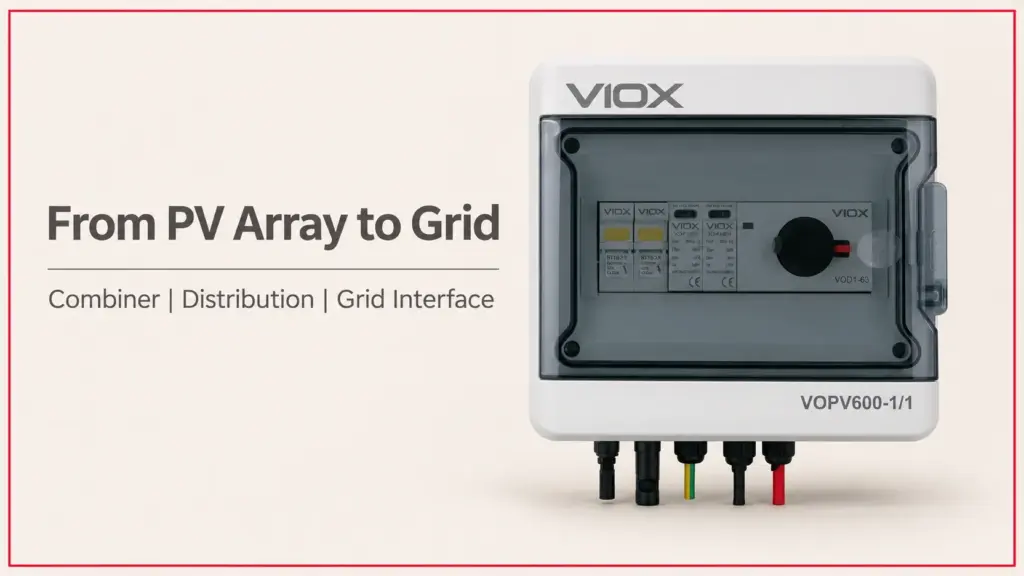
Short Answer
A combiner box combines DC strings before the inverter.
A distribution box splits AC power to loads after the inverter.
A grid connection cabinet provides the utility interface, carrying or coordinating interface protection and import/export metering.
These are three functions, not necessarily three mandatory standalone enclosures. A one-input PV protection box does not combine multiple strings, and an approved inverter/main-panel arrangement may already provide the grid-interface functions. Utility metering can be housed inside a cabinet or in a separate meter enclosure.
For the detailed two-way comparison, use our sister site's Distribution Box vs Combiner Box: Key Differences. This guide follows the chain farther downstream: what the grid connection cabinet adds, where it belongs, and when it needs to be separate.
The chain, in order
Read the functional sequence from the generating source toward the utility:
Array -> combiner box -> inverter -> AC distribution -> grid connection cabinet -> utility meter -> utility grid.
Local loads branch from AC distribution; they are not downstream of the export meter in this conceptual reading. On the AC side, actual power can flow toward the utility during export and back toward the site during import. Some functions share an enclosure, and the utility-approved drawing determines the physical order and meter position.
| Step | What flows where | Side of the inverter | Typical indoor/outdoor placement |
|---|---|---|---|
| PV array | Modules supply DC string circuits | Before | Outdoors at the array |
| Combiner box or DC protection point | DC strings are collected or routed to the intended inverter inputs | Before | Commonly outdoors near the array, or in a suitable equipment area |
| Inverter | DC input becomes AC output | Conversion boundary | Indoors or outdoors, according to the inverter rating |
| AC distribution | AC connects the inverter with site distribution and branches to loads | After | Main electrical room, switchboard area or suitably enclosed outdoor position |
| Grid connection cabinet or integrated interface | AC passes through the defined utility-interface switching/protection arrangement | After | At the agreed connection/switchboard area, indoors or outdoors as approved |
| Utility meter | Import/export energy is measured at the agreed metering boundary | After | Utility-approved meter location; separate or integrated |
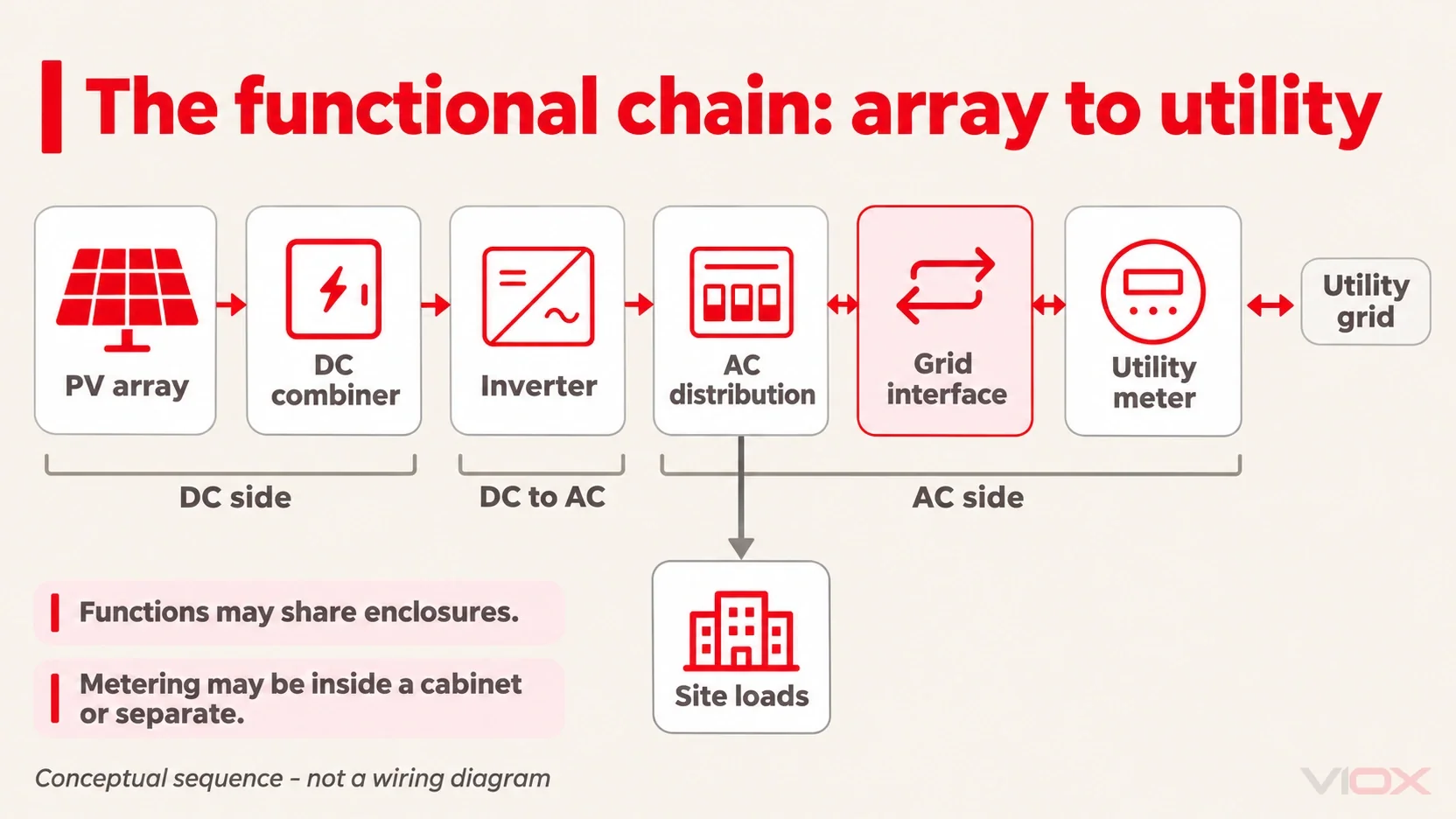
The location column is orientation, not permission to put an indoor assembly outside. Enclosure suitability and utility access requirements still apply. A separate DC combiner may also be unnecessary when the inverter accepts the strings directly.
What lives inside each box
Typical contents help identify the role, but the approved component schedule defines the actual assembly. The AC distribution entry below is deliberately a summary.
| Enclosure role | Typical devices | Voltage side | Typical location | What it protects or controls |
|---|---|---|---|---|
| PV combiner / DC protection box | String fuses; a suitable DC MCB where specified; DC isolator; Type 2 DC SPD where included | PV DC | Between array and inverter | String/collection circuits, DC switching and surge protection according to the fitted devices |
| AC distribution box | AC MCB/MCCB, RCCB/RCBO where required, AC SPD, busbar, neutral and earth bars | AC | Site switchboard/distribution area | Outgoing load circuits and assigned AC feeders |
| Grid connection cabinet | Interface protection for loss of mains/anti-islanding and over/under voltage and frequency; import/export metering provision; main switch and associated trip-capable interface switching | AC utility interface | Agreed connection point | Connection between generation and the utility; energy measurement and defined switching responsibility |
These are not universal bills of materials. For example, an RCCB is not an overcurrent protective device, an SPD does not provide anti-islanding, and a manual main switch alone cannot execute an automatic protection trip. Some interface functions are implemented in the inverter, while revenue metering may remain in a separate utility-controlled compartment.
The grid connection cabinet, in depth
Why the utility wants a defined interface point
A solar plant becomes part of the electrical network when it operates in parallel with the utility. The utility needs a clear answer to three questions: where can generation be disconnected from the network, which equipment decides when that must happen, and where is exchanged energy measured?
A defined interface assigns those responsibilities. It gives the designer, installer, owner and network operator an agreed boundary for drawings, access, protection coordination and commissioning records. A cabinet can bring the relevant devices together, but the cabinet shell itself performs none of those functions.
"Grid connection cabinet" is a project or supplier label rather than a guarantee of identical equipment everywhere. Another project may call the arrangement an interface panel, connection switchboard or part of the main switchboard. Read the single-line diagram and equipment schedule to establish what the name includes.
This functional distinction appears in network documentation: Energy Networks Australia's grid-connection guidelines describe interface protection in relation to the generation installation and the connected grid. Their local implementation is not a rule to copy into every country.
What interface protection does when the grid fails or goes out of range
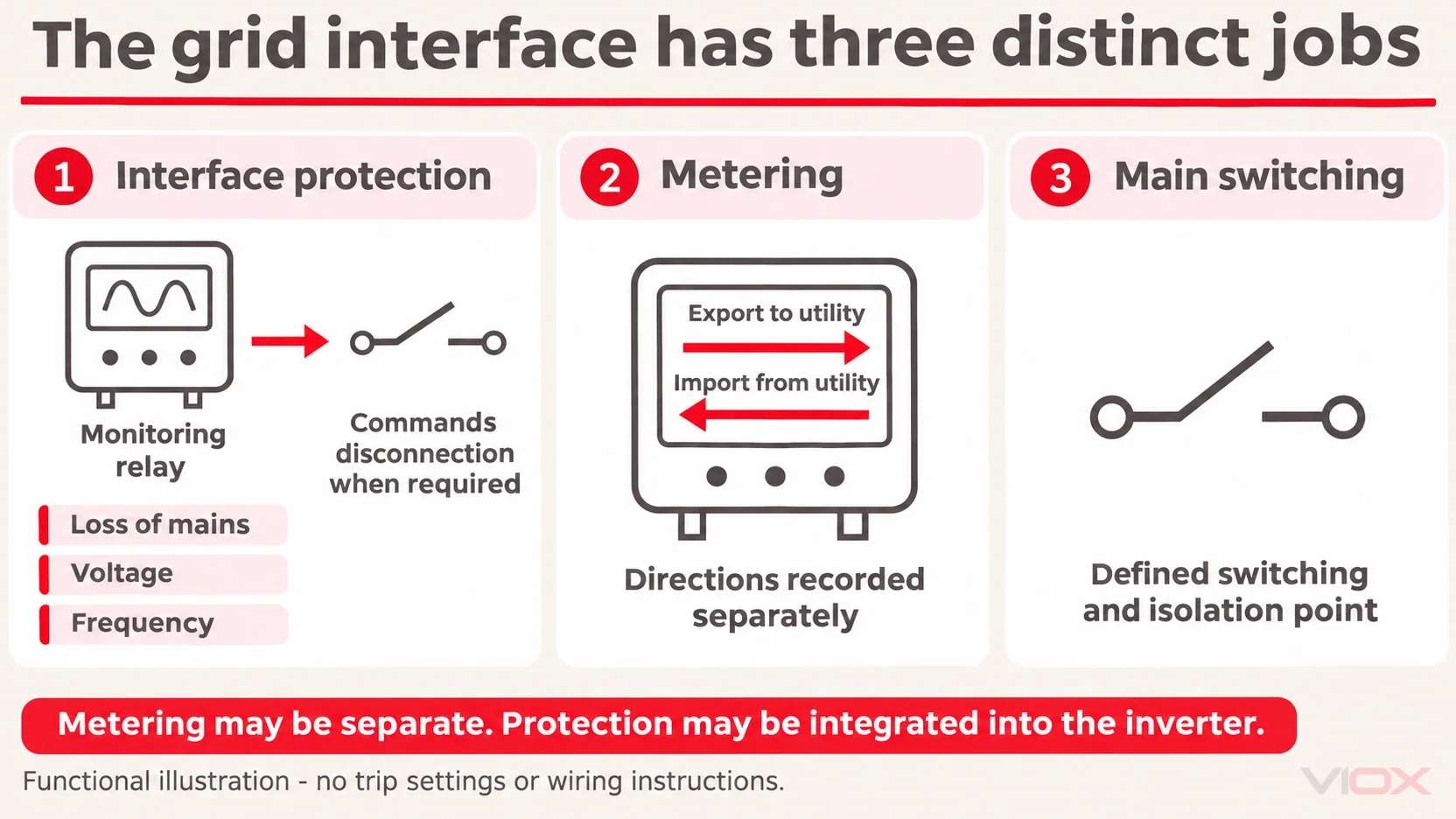
Interface protection monitors the conditions relevant to continued parallel operation. Its assigned functions can include loss-of-mains or anti-islanding protection, over/under voltage and over/under frequency protection. When the agreed trip conditions are met, the protection system commands the appropriate interface device or inverter to disconnect generation from the utility.
Loss of mains matters because a PV system must not unintentionally sustain an isolated section of the public network after its normal supply disappears. Anti-islanding addresses that condition. Voltage and frequency protection address operation outside the permitted connection envelope; they are not the same function as an outgoing load-circuit breaker.
Not every brief disturbance requires an immediate trip. Utilities may require generation to remain connected through specified disturbances and disconnect for others. The approved local settings and response requirements determine the action. This guide supplies no universal threshold, delay or reconnection setting.
IEC 62116, Utility-interconnected photovoltaic inverters - Test procedure of islanding prevention measures, provides a test procedure for islanding prevention measures installed in or with PV inverters. Its scope does not establish that a particular installation is approved or that every project needs a separate protection cabinet.
A tripped grid interface also does not make the whole PV installation dead: illuminated modules can still produce DC. Nor does it automatically provide backup power to the building. Intentional backup operation needs an approved arrangement that separates the backed-up circuits from the public network and supports them appropriately. Interface protection and backup supply are distinct design questions.
What metering does, and why import and export are recorded separately
Import is energy drawn from the utility; export is energy delivered to it. These flows can occur at different times and can receive different billing or settlement treatment. Recording their directions separately preserves the information needed to account for the exchange.
Separate records do not necessarily mean two physical meters. A bidirectional revenue meter can hold distinct import and export registers. ENGIE's meter-reading guide illustrates separate usage and export registers. Meter ownership, approved type, location and accounting arrangement depend on the project and utility.
An inverter's production total is a different measurement. Some solar output may be consumed on site before reaching the grid boundary, so total generation is not automatically the exported energy. Likewise, an inverter monitoring sensor or export-control meter is not automatically the utility's revenue meter.
The cabinet may therefore contain metering equipment, current-transformer provisions or an agreed metering compartment, or it may connect to a separate utility meter. Identify which device measures which boundary. The utility's approved metering arrangement decides the placement; a generic cabinet name does not.
When a separate cabinet is needed
A separate cabinet is needed when the utility-approved arrangement requires one, or when the project assigns interface equipment to a dedicated assembly. Reasons can include a common protection/disconnection point for several inverters, a specified metering compartment, utility access, or equipment that the existing main panel cannot suitably accommodate.
The important purchasing question is not "How many cabinets does solar always need?" It is "Where does this approved connection arrangement put each required function?" A relay without the correct trip path, or a cabinet without the required metering provision, can leave that answer incomplete.
Ask the supplier to identify the monitoring point, the device that opens, the equipment it disconnects and the location of the revenue meter. A box described simply as "grid-connected" does not establish those details.
When the inverter and main panel already cover the function
A rooftop system may use accepted inverter-integrated protection, appropriately arranged main-panel switching/protection and the required utility meter without an additional standalone grid cabinet. This is a valid outcome when the utility accepts the complete arrangement; it is not a universal exemption for small systems.
Energy Networks Australia's small-generation guidelines distinguish inverter-integrated protection from additional interface protection and allow network requirements to define when the latter is needed. The general lesson is to check the actual connection conditions, not to transplant one jurisdiction's size categories or settings.
Three confusions to avoid
1. Combining sources is different from distributing to loads
A combiner collects source circuits; the AC distribution role here branches power to loads. Follow the intended circuit role and direction of collection or branching. AC power can reverse during import/export, so instantaneous flow alone does not rename an enclosure. For the full two-way comparison, use the sister-site comparison.
2. A distribution box is not automatically a grid cabinet
An ordinary load distribution box does not, merely by having breakers and busbars, provide interface protection or utility revenue metering. Those functions must be specified and documented. A combined switchboard can contain them, but that is an explicit additional scope rather than a property of every distribution box.
3. "4-in-2-out" does not necessarily mean one common bus
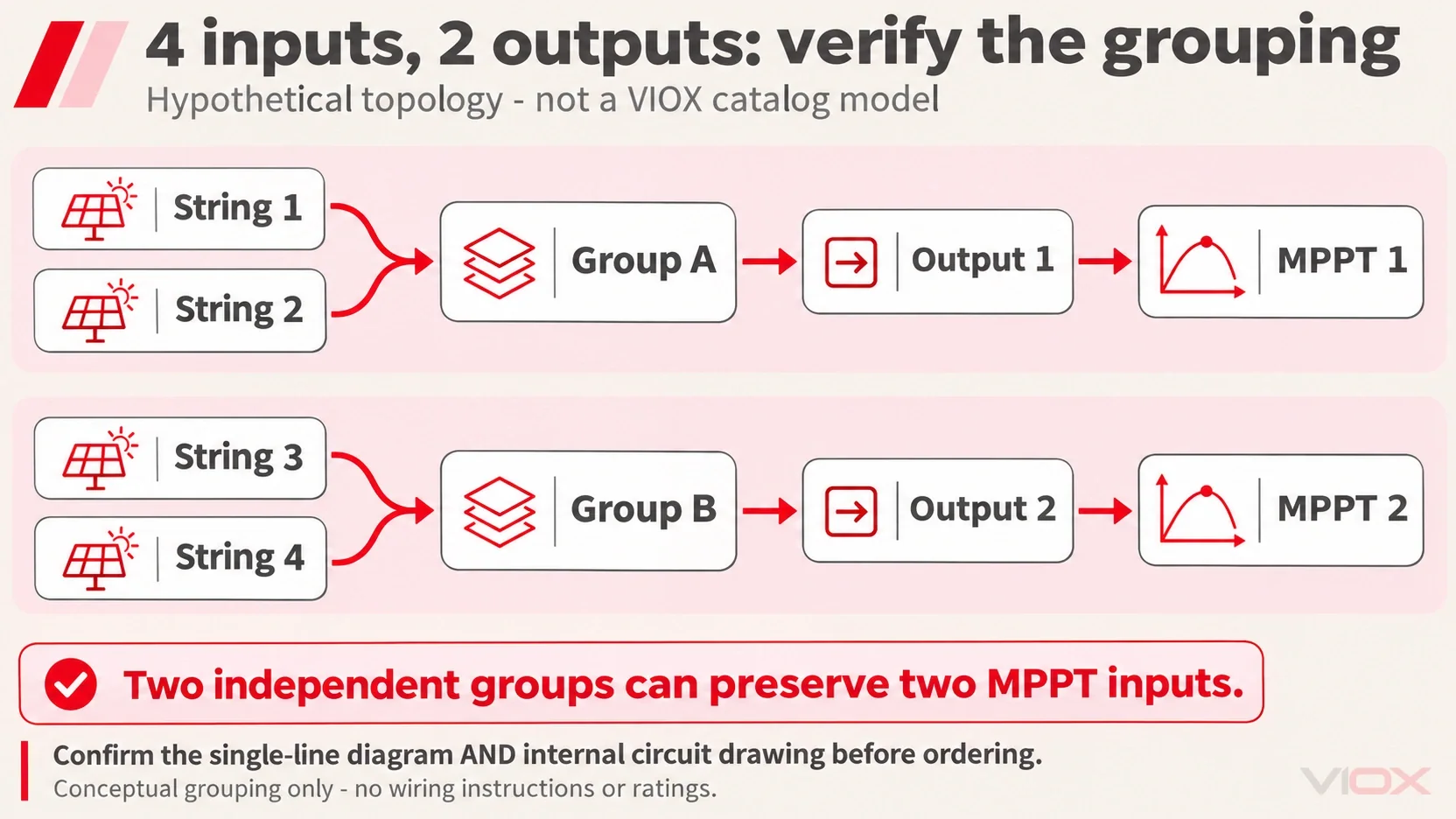
A hypothetical four-input, two-output combiner can collect two strings into one MPPT group and another two into a separate group. Joining all four inputs onto a common bus would change that topology and could defeat the intended MPPT separation.
Check both the single-line diagram and the internal circuit drawing before buying. Input/output counts alone do not prove which inputs share a bus or which output serves each tracker. This four-input illustration is a topology example, not a VIOX product offering.
Buying checklist
- Count the strings and identify their intended MPPT groups.
- State the DC system voltage and the separate AC/interface requirements.
- List the protection and switching functions already included in each supplied assembly.
- Confirm the outdoor IP rating and suitability of any exposed enclosure.
- Ask whether the utility requires a separate interface cabinet or accepts integrated equipment.
- Request the complete single-line diagram and the combiner's internal circuit drawing.
Where VIOX Solar products fit
VIOX Solar supplies the DC combiner/protection part of this chain. Vioxsolar does not sell AC distribution boxes or grid connection cabinets. This article explains those functions so buyers can assign the right scope to the right supplier.
The verified VOPV600-1/1, VOPV1000-3/1 and VOPV1000-3/3 product pages document the 600 V and 1000 V families, with one to three inputs across the range. They list 15 A, 10x38 mm string fuse links, Type 2 40 kA DC surge protection, a VOD1 isolator and IP65 enclosures. Device quantities and circuit arrangements depend on the model.
A 3/1 arrangement and a 3/3 arrangement do not describe the same collection task. Confirm the internal drawing and that the supplied 15 A links suit the project. These offerings are 600 V and 1000 V combiner boxes; VIOX Solar does not offer a 1500 V combiner box. The DC components do not provide the utility's AC interface protection or revenue metering.
Related resources
- What Is a PV Combiner Box?
- PV Combiner Box vs Junction Box
- How to Select a PV Combiner Box
- Building a More Reliable Industrial Distribution Panel
- DC Fuse Guide
FAQ
Is a combiner box the same as a distribution box?
No. In this solar chain, a PV combiner collects DC string circuits before the inverter, while an AC distribution box branches power to load circuits after it. A grid connection cabinet serves the separate utility-interface role. Suppliers sometimes use overlapping names, so confirm the circuit side, inputs, outputs and included functions on the drawing.
Do I need a grid connection cabinet for a rooftop system?
Not necessarily as a separate enclosure. The utility may accept inverter-integrated interface protection, suitable main-panel equipment and an approved meter arrangement. Other projects require a dedicated interface cabinet. Check the local utility's connection conditions and approved single-line diagram; rooftop location alone does not determine the answer.
Can a distribution box be used as a combiner box?
An ordinary AC load distribution box cannot be substituted for a PV DC combiner merely because it has spare ways or similar dimensions. The required circuit arrangement, DC-rated protective and switching devices, and complete assembly suitability must be documented. A deliberately engineered dual-purpose assembly is a specified design, not an assumed interchange.
Where does the grid connection cabinet sit in the system?
It belongs on the AC side between the site's generation/distribution arrangement and its utility connection. The meter may be inside that assembly or in a separate utility-approved location. The single-line diagram defines the actual order, boundaries and shared enclosures; a functional chain is not a universal physical layout.
What is inside a grid connection cabinet?
A specified cabinet typically includes interface protection for loss of mains and voltage/frequency conditions, the associated interface switching arrangement, a main switch and metering equipment or provision. Some protection may instead be integrated into the inverter, and the utility revenue meter may be separate. The approved schedule determines the actual contents.